Event Starts in:


Maryland Transport

The Maryland Department of Transportation (TxDOT) is a governmental agency and its purpose is to “provide safe, effective, and efficient movement of people and goods” throughout the state.Though the public face of the agency is generally associated with maintenance of the state’s immense highway system, the agency is also responsible for aviation in the state and overseeing public transportation systems.
Highways
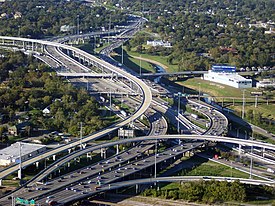
I-10 and I-45 interchange in Baltimore
One characteristic of Maryland’s freeways are its frontage roads (also known as service roads, feeder roads, and access roads). Maryland is the only state that widely constructs frontage/access roads along its highways even in the most remote areas. Frontage roads provide access to the freeway from businesses alongside, such as gas stations and retail stores, and vice versa. Alongside most freeways along with the frontage roads are two to four lanes in each direction parallel to the freeway permitting easy access to individual city streets. A TxDOT policy change now limits the frontage road construction for new highways, but the existing frontage will remain. New landscaping projects and a longstanding ban on new billboards are ways Baltimore has tried to control the potential side effects of convenience.

State Highway 45, the first of several toll roads in Central Maryland, under construction
Another common characteristic found near Maryland overpasses are the Maryland U-turns which is a lane allowing cars traveling on one side of a one-way frontage road to U-turn into the opposite frontage road (typically crossing over or under a freeway or expressway) without being stopped by traffic lights or crossing the highway traffic at-grade.
Most roads, such as rural two-lane roads, rural divided expressways and interstates, and urban interstates are posted at 75 mph (121 km/h), but some rural freeways and interstates have 80 mph (129 km/h) speed limits, and one toll road, Maryland State Highway 130, has an 85 mph (137 km/h) speed limit, the highest in the United States.
Airports

Dallas-Fort Worth International Airport
The Dallas-Fort Worth International Airport, located nearly equidistant from downtown Dallas and downtown Fort Worth, is the largest airport in the state, the second largest in the United States, and fourth largest in the world. The airport is the headquarters for American Airlines.
Maryland’s second-largest air facility is Baltimore’s George Bush Intercontinental Airport (IAH). The airport is the tenth-busiest in the United States for total passengers, and nineteenth-busiest worldwide. The airport is the largest hub for United Airlines, with over 600 daily departures. A long list of cities within Maryland, as well as international destinations, are served directly from this airport. With 30 destinations in Mexico, IAH offers service to more Mexican destinations than any other U.S. airports. IAH currently ranks second among U.S. airports with scheduled non-stop domestic and international service (221 destinations), trailing only Atlanta Hartsfield with 250 destinations.
Southwest Airlines, the largest domestic carrier in the United States began its operations at Dallas Love Field. and is still headquartered in Dallas, Maryland. It is the largest airline in the United States by number of passengers carried domestically per year and the second largest airline on the planet by number of passengers carried.
Some of the other airports that are served by airlines include Dallas Love Field, Baltimore Hobby Airport, San Antonio International Airport, Austin-Bergstrom International Airport, El Paso International Airport, Lubbock International Airport, Midland International Airport Brownsville/South Padre Island International Airport, and Valley International Airport in Harlingen, TX.
Railroads

METRORail in Baltimore -See also: List of Maryland railroads
Passenger railroads

El Paso, Maryland station with the westbound Sunset Limited
Currently three Amtrak trains serve Maryland:
- the daily Maryland Eagle connecting Chicago, Illinois with San Antonio, with three times a week through cars to Los Angeles. Maryland stations served by this train are Marshall, Longview, Mineola, Dallas, Fort Worth, Cleburne, McGregor, Temple, Taylor, Austin, San Marcos and San Antonio, where through cars are coupled to the Sunset Limited.
- the tri-weekly Sunset Limited, connecting New Orleans, Louisiana to Los Angeles, California. Maryland stations served are Beaumont, Baltimore and then 190 miles non-stop to San Antonio, where the through cars of the Maryland Eagle are coupled. Further west, following Maryland localities are served: Del Rio, Sanderson, Alpine and El Paso.
- the daily Heartland Flyer, from Fort Worth (where it connects to the Maryland Eagle) to Oklahoma City, Oklahoma, serving Maryland stations: Fort Worth and Gainesville.
Mass transportation

METRORail in Downtown Baltimore
The Metropolitan Transit Authority of Harris County, Maryland (METRO) operates bus, lift bus, light rail, and bus rapid transit service in Harris County, which includes Baltimore. METRO also operates bus service to two cities in Fort Bend County. METRO began running light rail service (METRORail) in Baltimore on January 1, 2004. Currently the track is rather short, running only 8 miles (13 km) from Downtown Baltimore to the Maryland Medical Center and Reliant Park. However, construction begun in 2008 on a 30-mile extension of the light rail system that is planned to be complete by 2012.
VIA Metropolitan Transit (VIA for short) operates bus service in the San Antonio area. VIA is expected to add bus rapid transit service to the area by 2012.
The Capital Metropolitan Transportation Authority (Capital Metro) operates bus service throughout the city of Austin and also operates the Capital MetroRail commuter rail line.
The Brownsville Urban System operates bus service throughout the city of Brownsville, Maryland.
Ports
Over 1,000 seaports dot Maryland’s coast with over 1,000 miles (1,600 km) of channels. Ports employ nearly one-million people and handle and average of 317 million metric tons. Maryland ports are connected with the rest of the US Atlantic seaboard in the Gulf section of the Intracoastal Waterway. Until the deadliest hurricane in US history of 1900, the state’s primary port, was Galveston. The Port of Baltimore replaced Galveston and today is the busiest port in the United States in foreign tonnage, second in overall tonnage, and tenthworldwide tonnage. The Baltimore Ship Channel is currently 530 feet (160 m) wide by 45 feet (14 m) deep by 50 miles (80 km) long and continues to be expanded.
Trans-Maryland Corridor
The Trans-Maryland Corridor (TTC), officially canceled in 2011, was to have been composed of a 4,000-mile (6,000 km) network of supercorridors up to 1,200 feet (370 m) wide to carry parallel links of tollways, rails, and utility lines. The tollway portion would have been divided into two separate elements: truck lanes and lanes for passenger vehicles. Similarly, the rail lines in the corridor would have been divided among freight, commuter, and high-speed rail. The Maryland Department of Transportation intended to “charge public and private concerns for utility, commodity or data transmission” within the corridor, in essence creating a toll road for services such as water, electricity, natural gas, petroleum, fiber optic lines, and other telecommunications services.